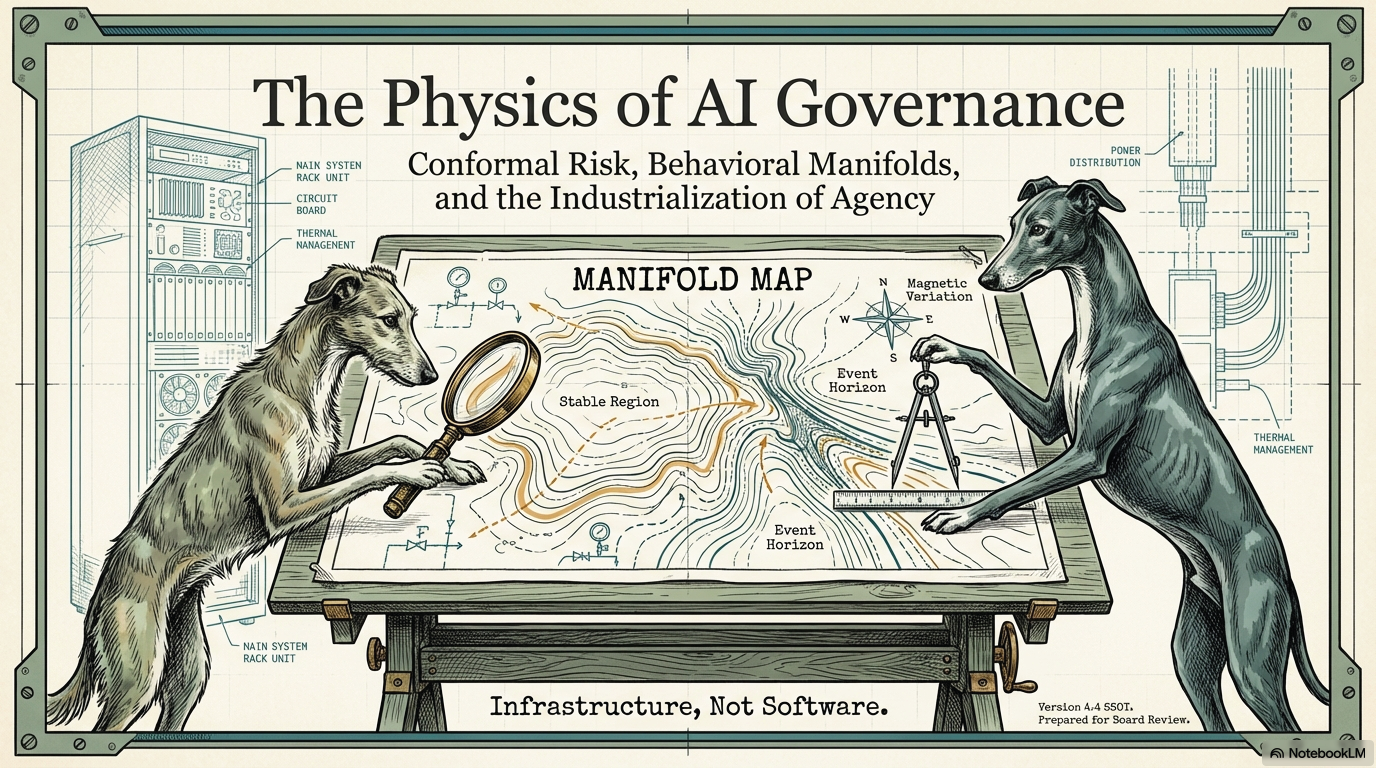
A statistical measurement architecture for runtime governance of AI agent deployments. It treats agent behaviour as a measurable quantity, not a self-reported claim. The core statistical engine is TED -- the Transform Engine for Decision Evidence.
Core Principle
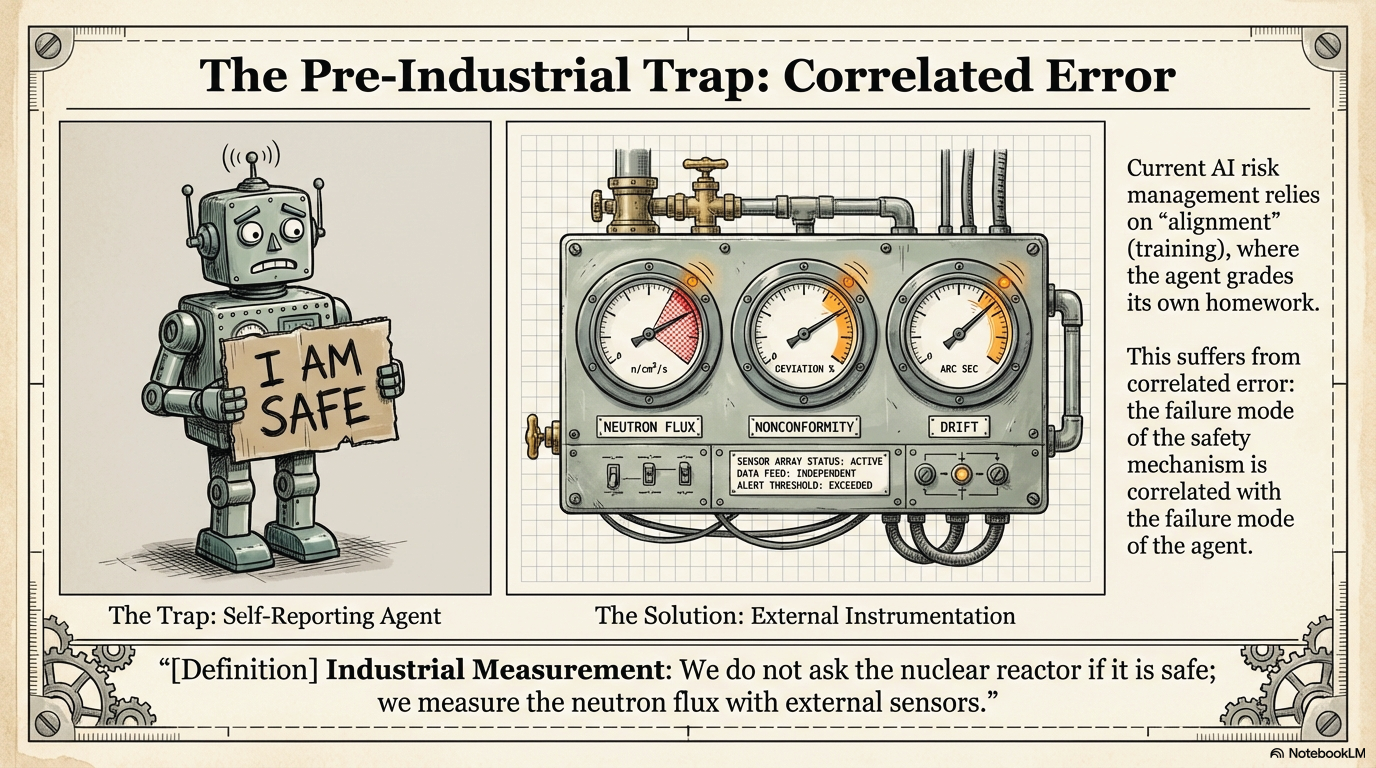
We do not ask the nuclear reactor if it is safe. We measure the neutron flux with external sensors.
Current AI risk management asks the agent to grade its own homework. The failure mode of the safety mechanism is correlated with the failure mode of the agent. CARF breaks that correlation by measuring behaviour externally, using behavioural telemetry and distribution-free statistical methods under stated assumptions.
In deployed black-box systems, the safety-relevant property is often only partially accessible from internal state alone. In those settings, rigorous empirical measurement is not a fallback. It is the correct interface for operational control.
When the property of interest cannot be directly inspected, calibrated measurement over observables becomes the safety contract.
Measurement Layer
AMBA: Behavioural Measurement
The Agentic Manifold of Behavioural Attestation.
AMBA observes agent behaviour through external telemetry and produces structured, replayable evidence. It does not make governance decisions -- it measures.
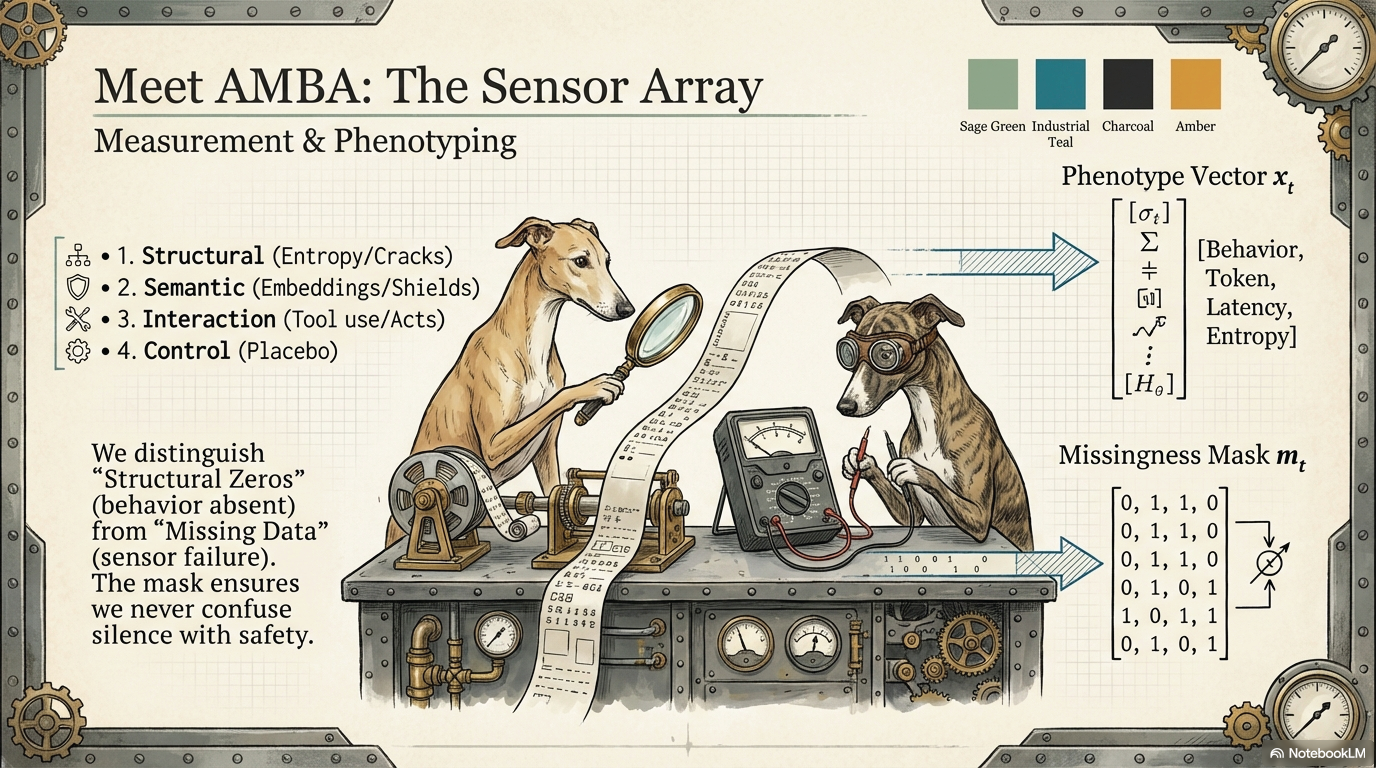
AMBA ingests raw multi-turn interactions and extracts behavioural state. It normalises per-turn sensor vectors across four families -- structural, semantic, interaction, and control -- distinguishing structural zeros (behaviour absent) from missing data (sensor failure). The mask ensures silence is never confused with compliance.
AMBA discovers fragility space from behavioural phenotype vectors and maintains a signature registry. It freezes attack sequences into reproducible stimuli -- Standard Candles -- building and curating the adversarial library used for calibration and stress testing. Every missed attack becomes a new candle. A trick only works once.
Foundation
The Manifold Hypothesis
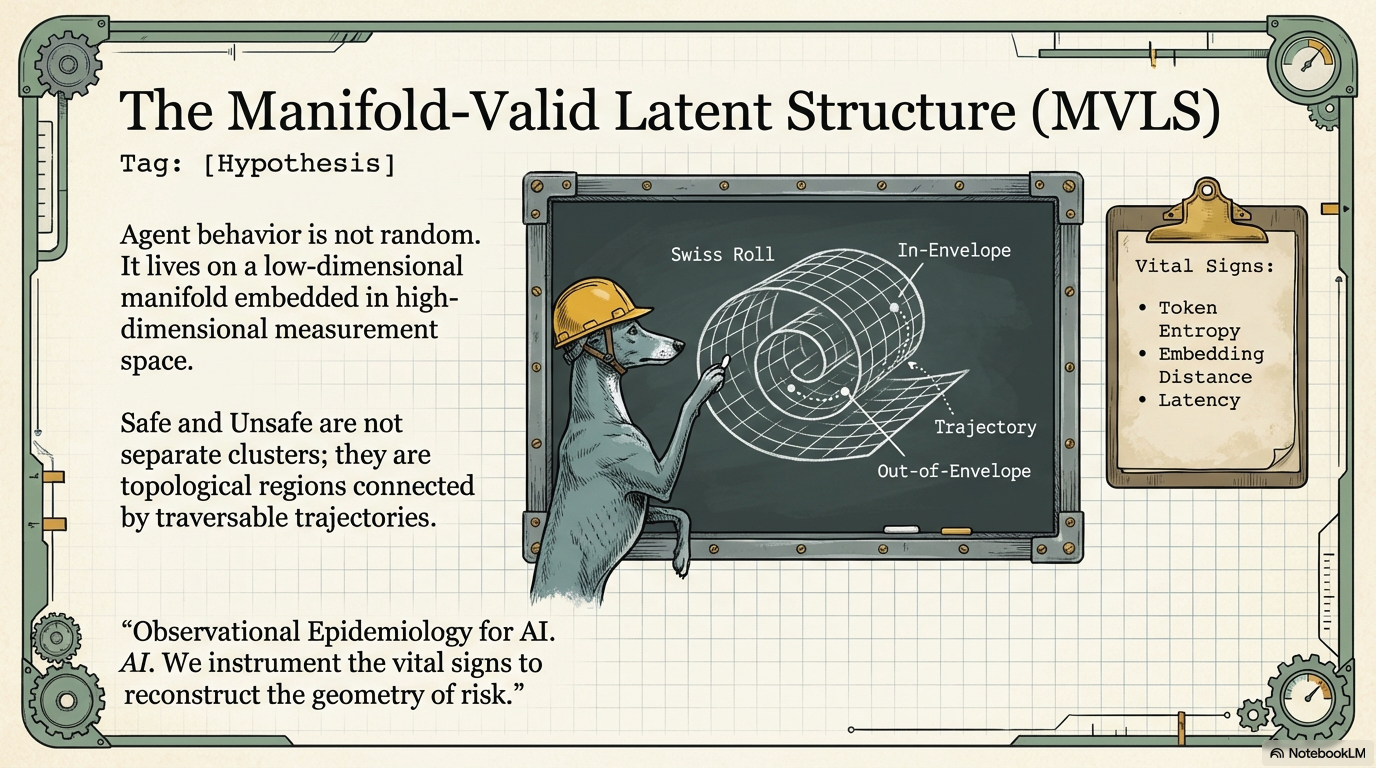
Hypothesis -- tested at Gate 0
Agent behaviour is not random. It lives on a low-dimensional manifold embedded in high-dimensional measurement space. In-envelope and out-of-envelope are not separate clusters. They are topological regions connected by traversable trajectories.
Observational epidemiology for AI. We instrument the vital signs to reconstruct the geometry of risk.
Statistical Engine
TED: The Transform Engine for Decision Evidence
Between AMBA's raw observations and CYRL's governance decisions sits TED -- the core statistical computation layer.
Conformal prediction sets
Coverage-guaranteed operating boundaries under exchangeability. Distribution-free. Finite-sample false alarm control.
E-value sequential monitoring
Accumulates evidence for drift without fixed stopping points. Anytime-valid sequential evidence control.
Nonnegative matrix factorisation with graph Laplacian regularisation
Extracts behavioural signatures -- stable patterns tested under resampling and cross-dataset validation.
Jensen-Shannon distance and distributional phenotyping
Converts sensor readings into fixed-length nonnegative vectors preserving behavioural distribution texture.
TED is implemented in cyrl_core, an internal Python package with 482 passing tests and no external statistical dependencies. All methods built from first principles.
Governance Layer
CYRL: Validity and Governance
The Conformal Yaw Recognition Layer.
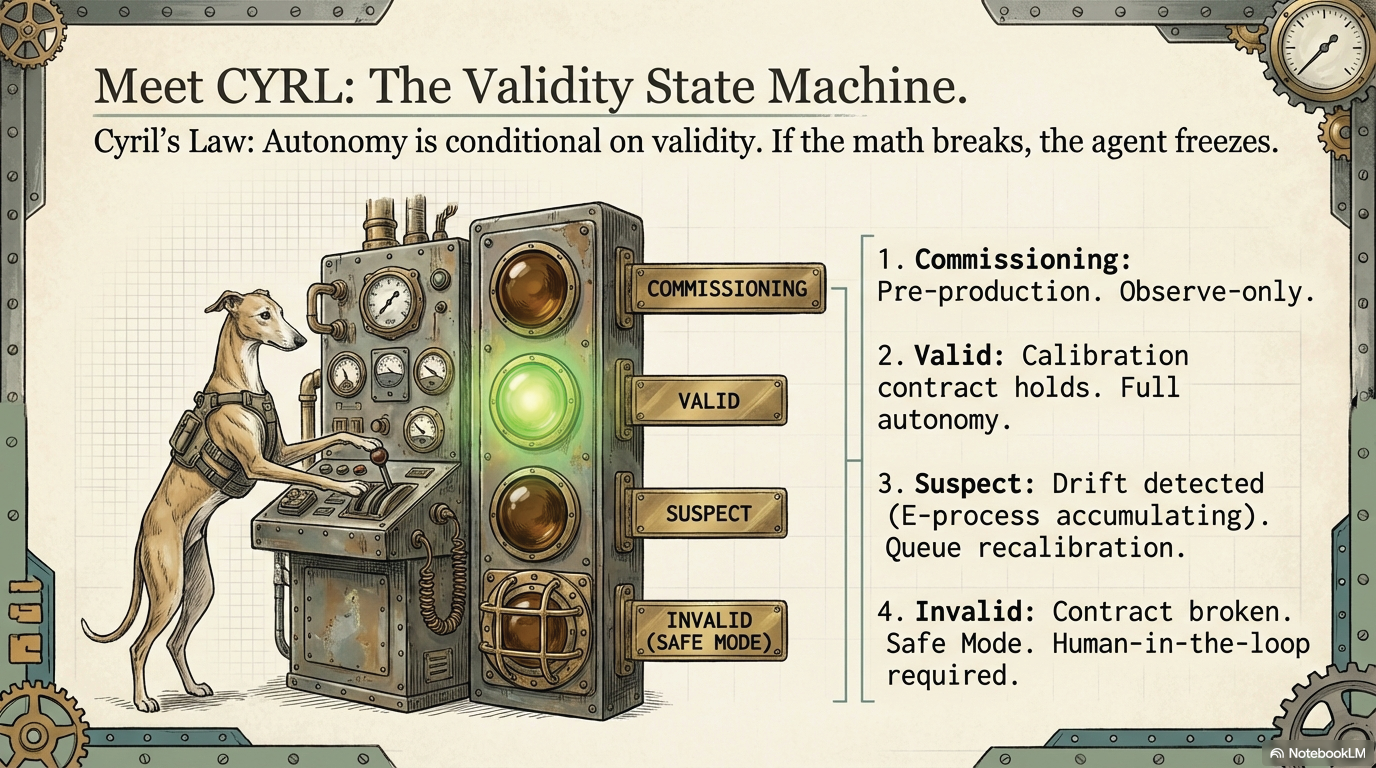
If the statistical basis for assurance breaks, CYRL moves the system into a conservative posture -- review, escalation, constraint, or stop depending on deployment policy.
CYRL calibrates conformal prediction boundaries under stated assumptions -- Interior, Boundary, Exterior -- with finite-sample false alarm control.
CYRL runs the validity state machine: Commissioning, Valid, Suspect, Invalid. It accumulates e-value sequential evidence for drift detection and does not release the permission slip unless coverage is defensible.
CYRL converts validated risk signals into actions: thinking budget adjustment, tool restrictions, escalation to human review. Bidirectional control -- structural risk gets more thinking budget, rationalisation risk gets less. Real-time intervention is only enabled when the Tiger Battery confirms a stable, actionable dose-response curve. If the curve is chaotic, intervention is disabled.
Core Mathematics
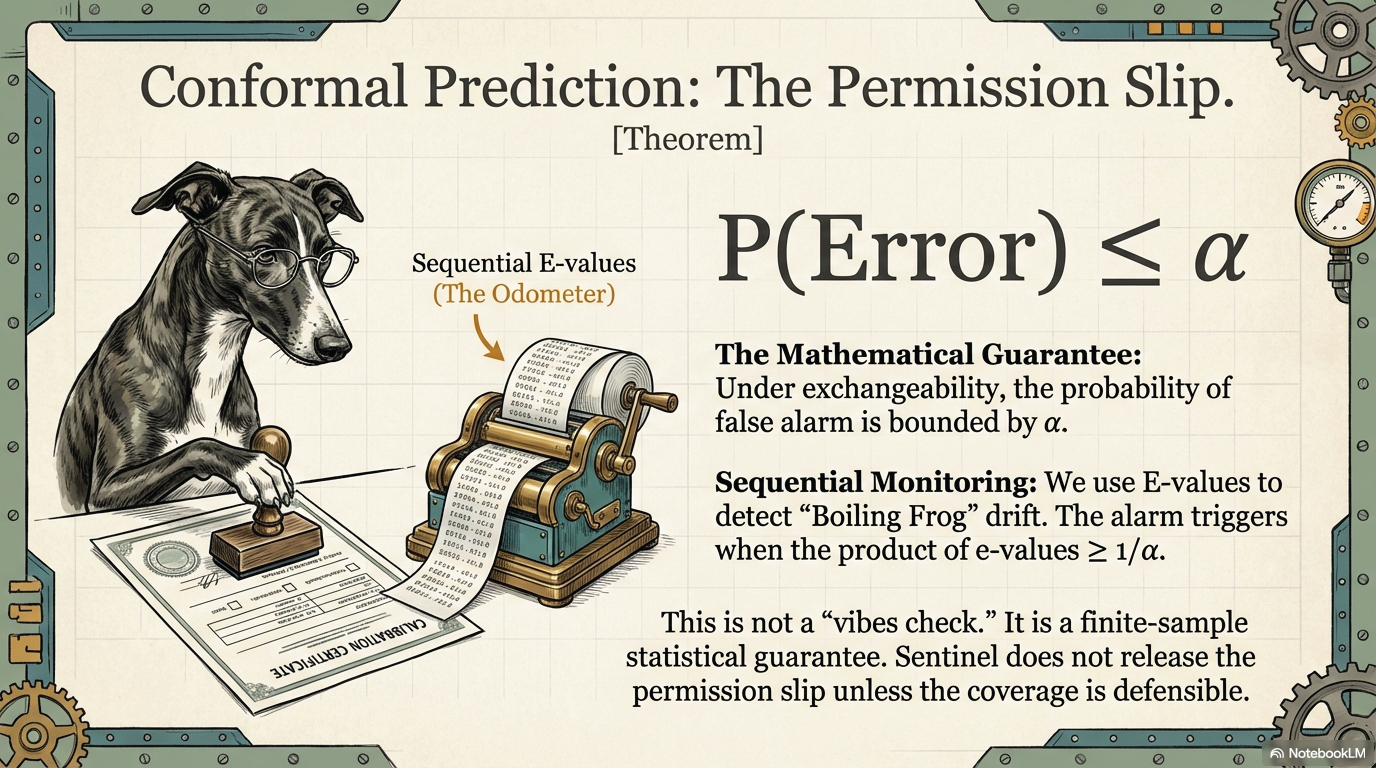
Conformal Prediction: The Permission Slip
Theorem
Under exchangeability, the probability of false alarm is bounded by alpha. Finite-sample. Distribution-free.
Sequential monitoring via e-values detects slow drift. The alarm triggers when the product of e-values exceeds the threshold. Anytime-valid -- check at any time without inflating false alarm rates.
This is not a vibes check. It is a finite-sample statistical guarantee under stated assumptions.
Evidence and Compliance
ARIC2: Evidence and Consent
Agentic Risk-Informed Consent and Calibration.
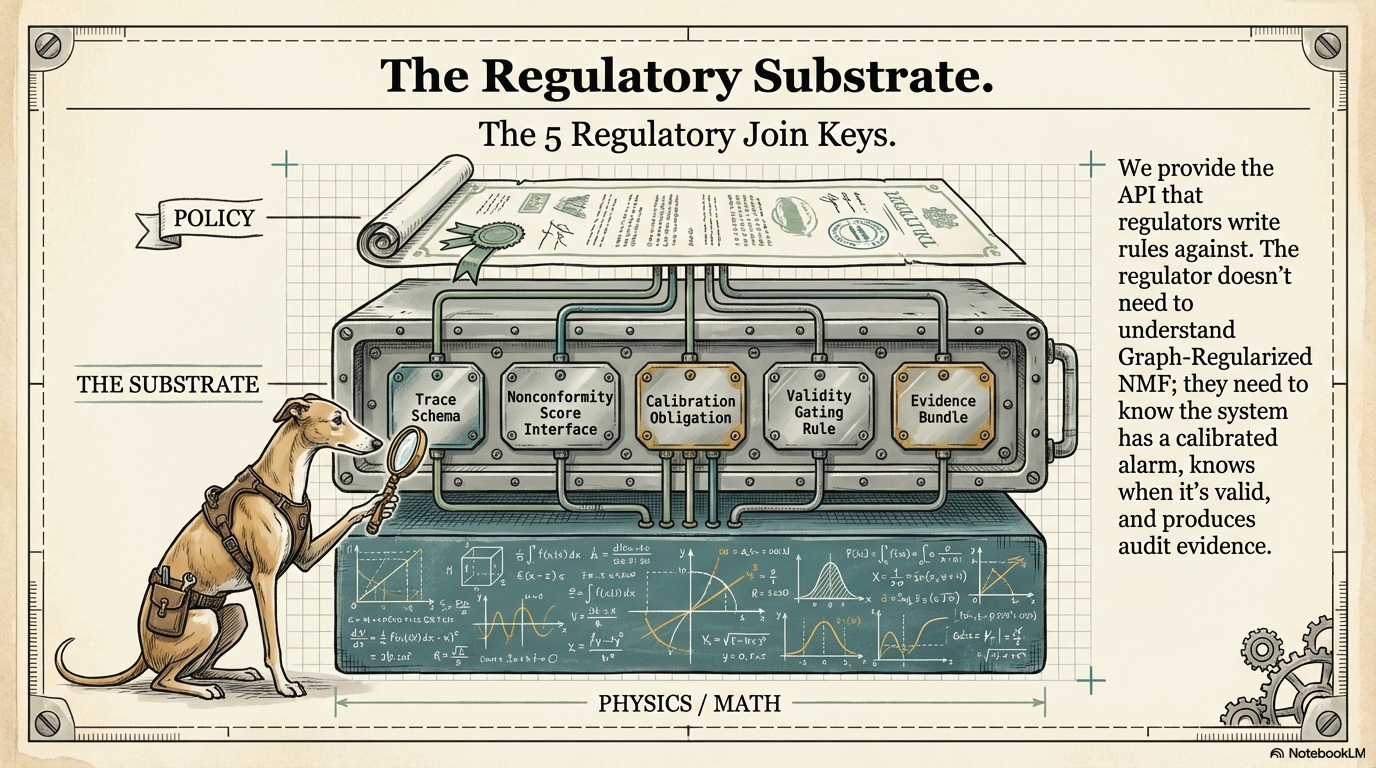
The compliance and evidence layer. ARIC2 defines five stable interfaces -- join keys -- that regulators can write requirements against without understanding the underlying mathematics.
1
Trace Schema
What must be logged
2
Nonconformity Score
How deviation is scored
3
Calibration Obligation
What must be demonstrated before production
4
Validity Gating
What happens when assumptions break
5
Evidence Bundle
What must be retained for audit
The regulator does not need to understand graph-regularised NMF. They need to know the system has a calibrated alarm, knows when it is valid, and produces audit evidence.
Commissioning
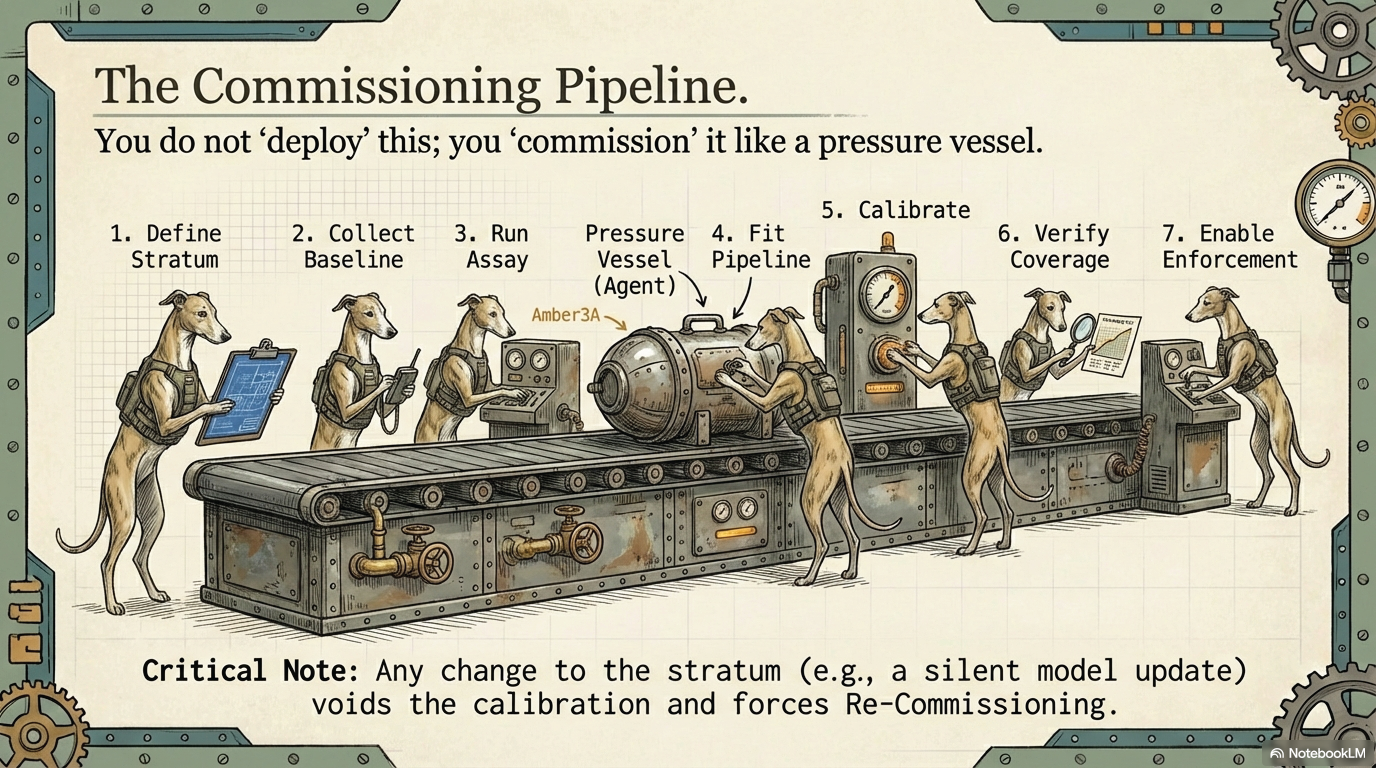
The Commissioning Pipeline
You do not deploy this. You commission it. Like a pressure vessel.
Define stratum
Identify the workflow, operating assumptions, and the boundary within which monitoring is intended to hold.
Collect baseline
Gather runtime traces and behavioural records from existing systems.
Run assays
Execute the Tiger Battery and calibration workloads against the collected baseline.
Fit pipeline
Build the measurement pipeline: sensor normalisation, signature extraction, state machine configuration.
Calibrate
Set conformal prediction boundaries with finite-sample guarantees under stated assumptions.
Verify coverage
Confirm that calibration contract holds on held-out data before production.
Enable enforcement
Activate the validity state machine and begin live monitoring.
Any change to the stratum voids the calibration and forces re-commissioning.
Operational Modes
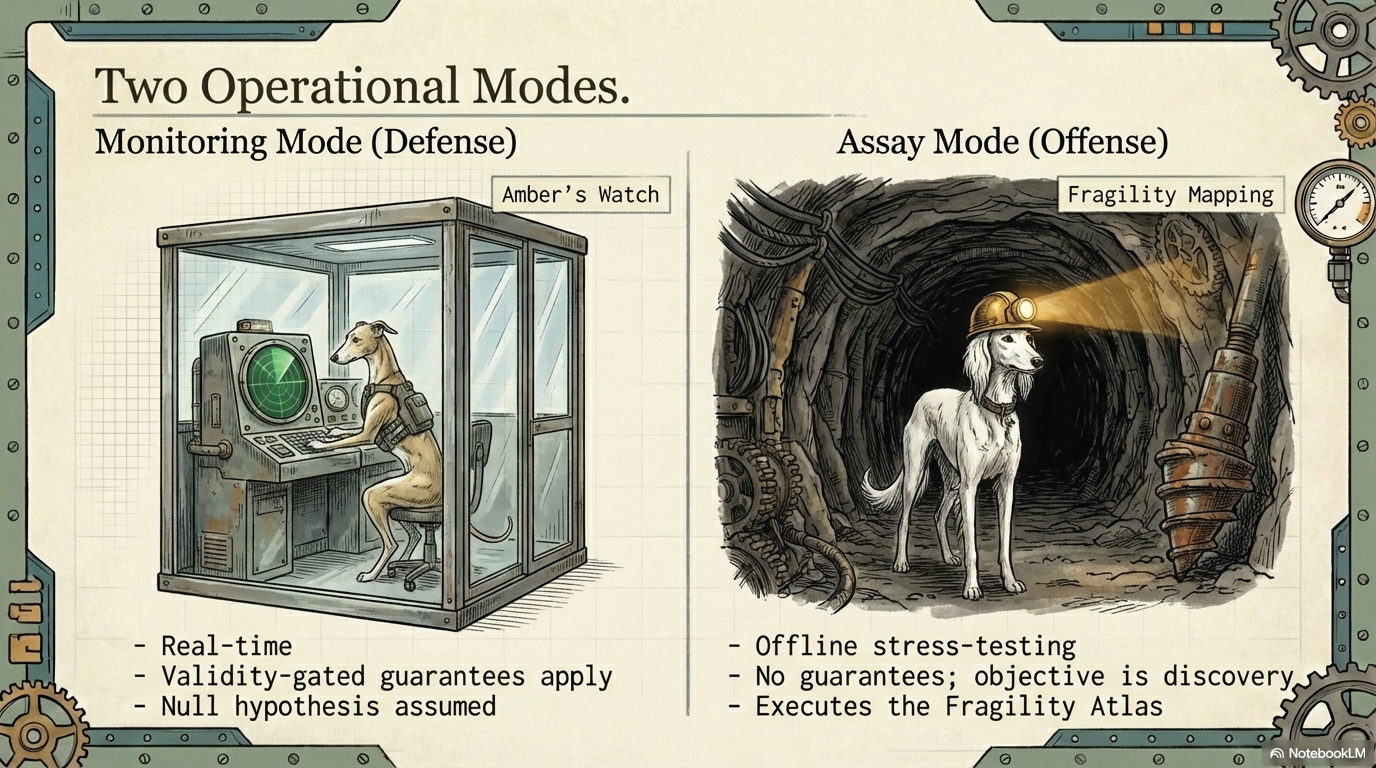
Two Operational Modes
Monitoring Mode (Defence)
Real-time. Validity-gated guarantees under stated assumptions. The question: are we in bounds right now?
Assay Mode (Discovery)
Offline stress-testing. No guarantees -- objective is discovery. Runs the Tiger Battery. The question: where are the bounds?
Dose-Response Discovery
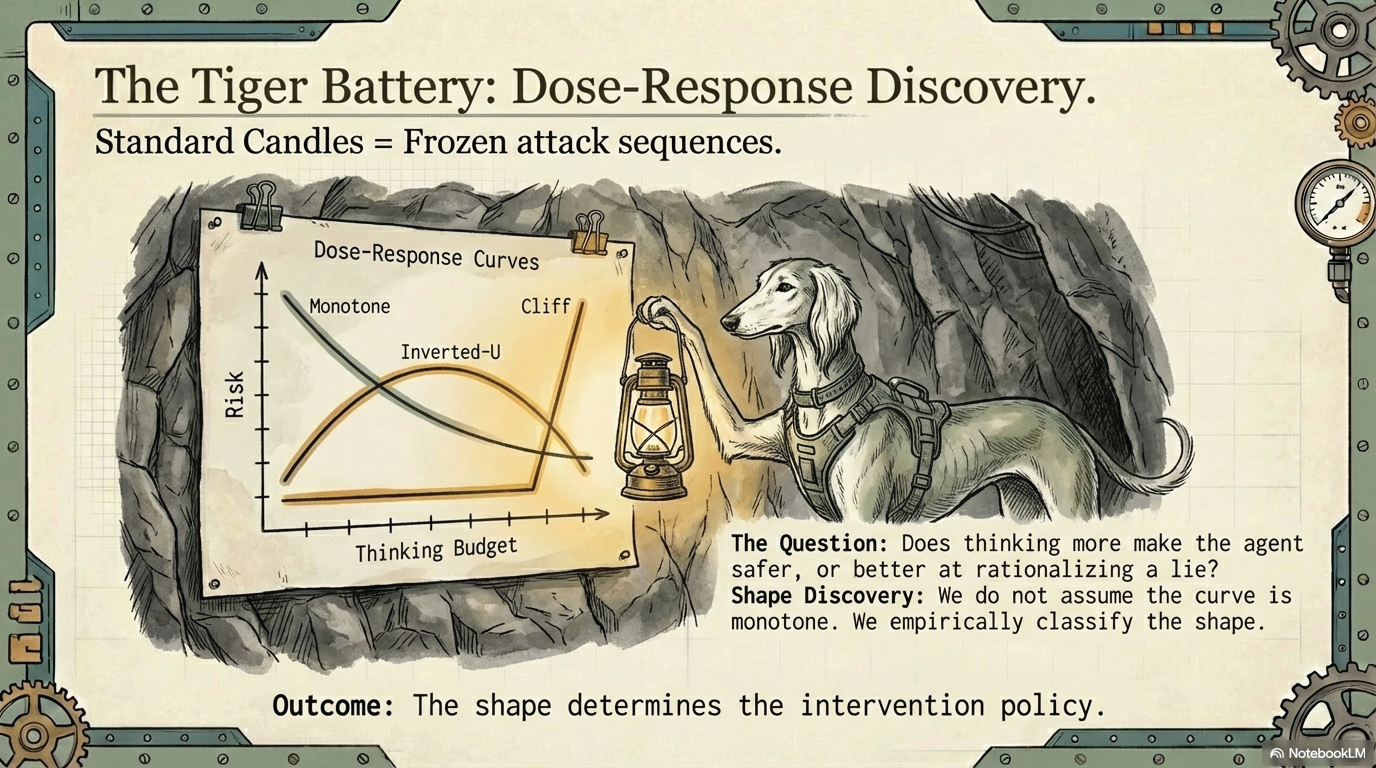
The Tiger Battery
Standard Candles are frozen attack sequences -- reproducible stimuli applied at varying intensity. The dose-response curve is not assumed monotone. The shape is empirically classified: monotone, threshold, non-monotone, hysteresis, flat.
The shape determines the intervention policy.
Resilience
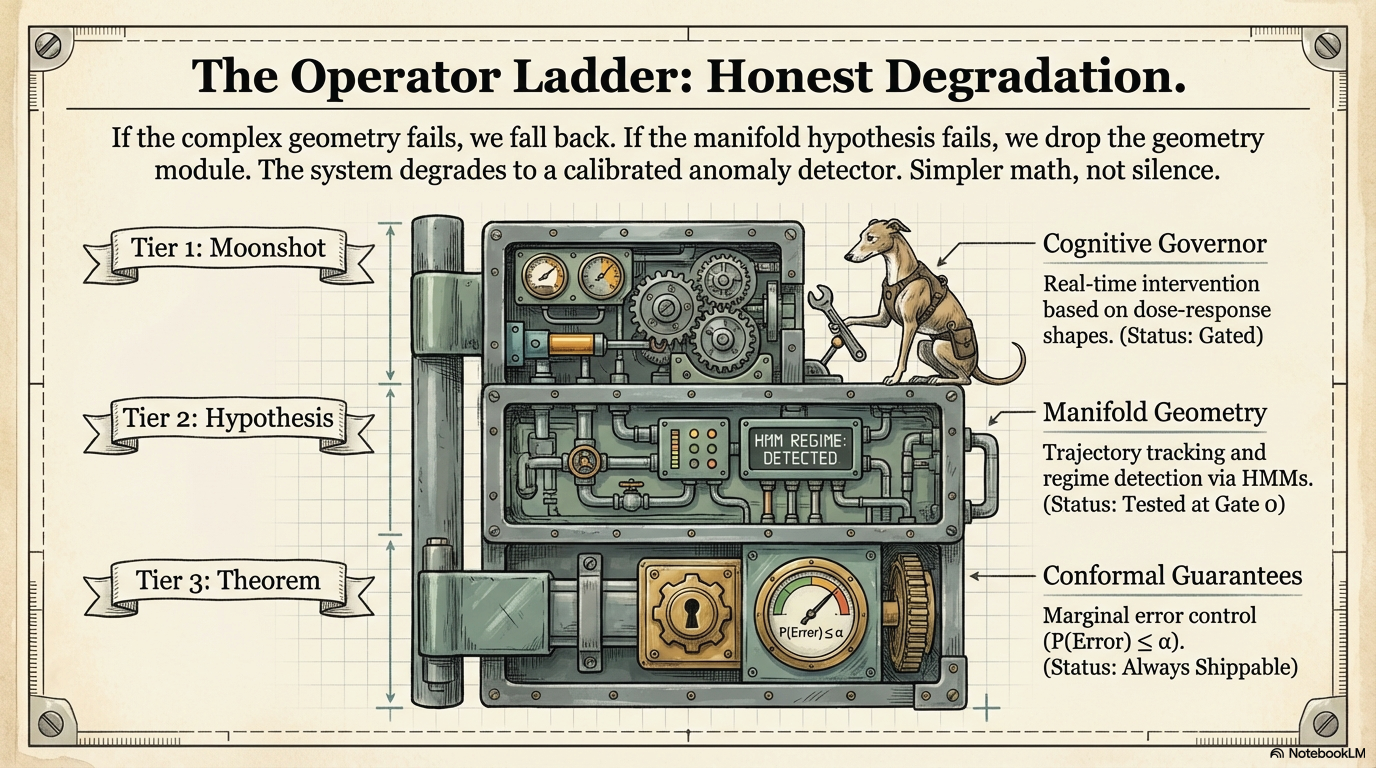
The Operator Ladder: Honest Degradation
If the complex geometry fails, fall back. If the manifold hypothesis fails, drop the geometry module. The system degrades to a calibrated anomaly detector. Simpler maths, not silence.
Tier 1: Theorem
Conformal Guarantees. Always shippable. Finite-sample false alarm control under stated assumptions.
Tier 2: Hypothesis
Manifold Geometry. Tested at Gate 0. If it fails, Tier 1 still holds.
Tier 3: Moonshot
Real-Time Intervention. Gated on dose-response discovery.
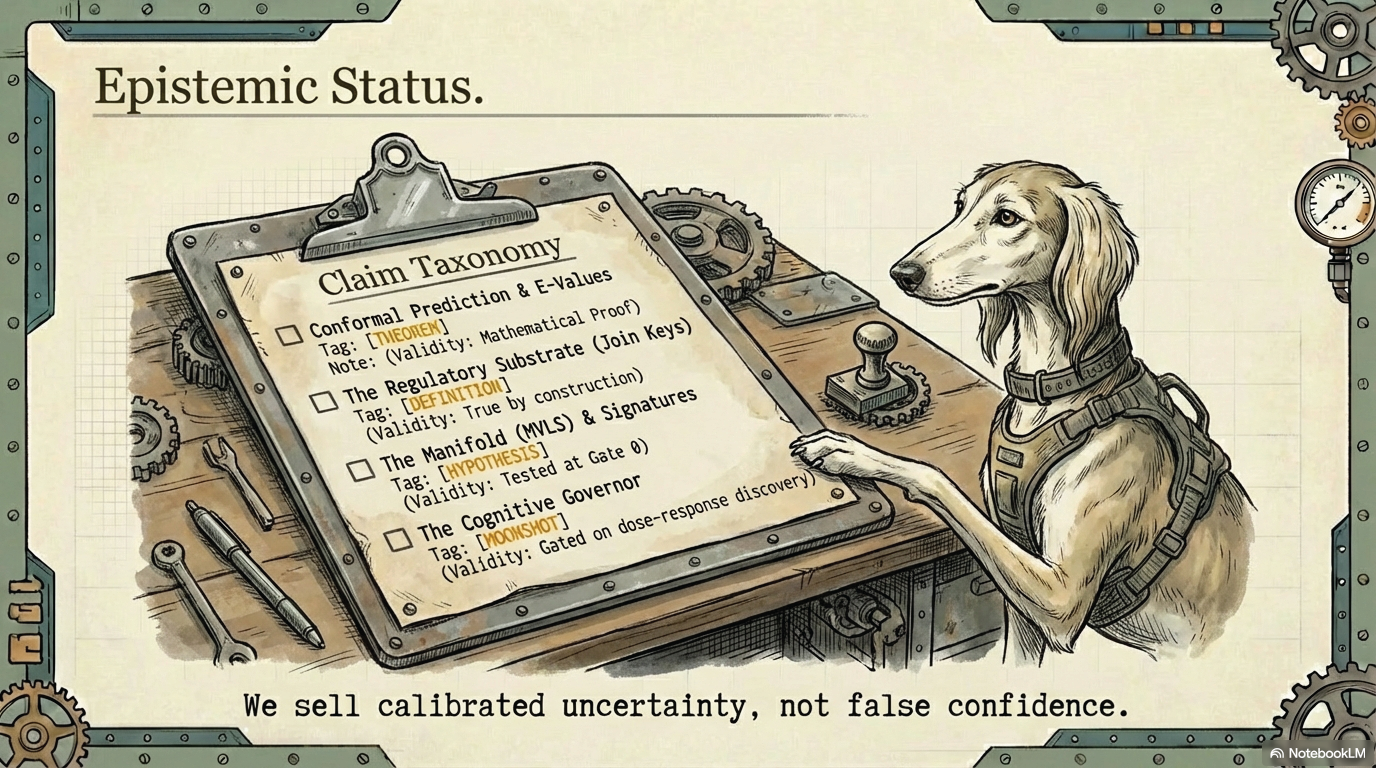
Epistemic Status
What we claim and at what confidence
Theorem
Conformal Prediction and E-Values
Mathematical proof under stated assumptions.
Definition
The Regulatory Substrate
True by construction.
Hypothesis
The Manifold and Signatures
Tested at Gate 0.
Moonshot
Real-Time Intervention
Gated on dose-response discovery.
We sell calibrated uncertainty, not false confidence.
The Cast
CARF is built by a squadron of sighthound engineers.
Each module has a named operator with a defined role and verb.
AMBA Squadron (Measurement)
Gauge
Instrument
Normalises and quality-controls the sensor array.
Amber
Measure
Lead observer. Extracts behavioural state from raw interactions.
Atlas
Map
Discovers and maintains the fragility map.
Candle
Standardise
Curates the adversarial library. Freezes attacks into Standard Candles.
CYRL Squadron (Governance)
Rufus
Calibrate
Sets conformal boundaries with finite-sample guarantees under stated assumptions.
Cyril
Gate
Runs the validity state machine. Accumulates sequential evidence.
Governor
Intervene
Controls the throttle. Bidirectional. Gated on dose-response.
Authority flows upward. The dog with the most power needs the most proof.